Most people who switch to streaming television have no idea how the IPTV industry actually works behind the scenes. They know there are IPTV providers, they know some are good and some are terrible, but the inner workings — who runs these services, where the channels come from, why prices vary so wildly, and what genuinely separates one provider from another — remain a complete mystery.
That mystery is exactly what allows bad operators to thrive. When viewers do not understand how IPTV providers work, they cannot tell the difference between a professional, well-run service and a reseller operating out of a bedroom who will vanish in a month. Knowledge is protection.
This guide pulls back the curtain. We will explain the different types of IPTV providers, how the technology and supply chain actually function, why there is such a vast range in quality and price, and how to use this understanding to choose a provider you can rely on. Whether you are completely new to IPTV or you have been burned by a bad provider before, understanding how the industry works will make you a far smarter consumer.
What Are IPTV Providers, Exactly?
At the most basic level, IPTV providers are services that deliver television channels and on-demand content to you over the internet rather than through a satellite dish or cable connection. IPTV stands for Internet Protocol Television — it is simply television delivered using the same internet technology that powers websites, video calls, and streaming apps.
But the term « IPTV providers » covers an enormous range of different operations, from massive licensed corporations to individuals reselling access from their living room. Understanding where a provider sits on this spectrum is the key to understanding what you are actually buying.
When you sign up with any IPTV service, you are essentially paying for two things: access to a stream of television content, and the infrastructure that delivers it reliably to your device. The quality of both varies enormously between providers — and that variation is exactly why some IPTV providers deliver flawless 4K streams during the busiest matches while others collapse into buffering chaos the moment more than a few people log on.
The Different Types of IPTV Providers
Not all IPTV providers are the same. In fact, they fall into several distinct categories, each operating very differently. Understanding these categories is the foundation of making a smart choice.
Fully Licensed IPTV Providers
At one end of the spectrum are the fully licensed IPTV providers — the official streaming services operated by broadcasters and major media companies. In Ireland, this includes services like the RTÉ Player, Sky Go, Virgin Media Player, and international platforms like Netflix, Disney+, and Amazon Prime Video.
These providers pay directly for the rights to distribute their content. They operate entirely within the legal and licensing framework, which is why their content libraries are sometimes more limited and their prices are higher. When you subscribe to Netflix or Sky Go, you are dealing with a fully licensed IPTV provider.
The trade-off with licensed providers is cost and fragmentation. To access everything you want — Irish channels, UK channels, sport, films, box sets — you typically need to subscribe to multiple licensed services simultaneously, with the combined cost easily exceeding €100 per month.
Independent IPTV Service Providers
In the middle of the spectrum are independent IPTV providers who operate as technology platforms, aggregating large numbers of channels and on-demand content delivered through their own server infrastructure. These providers offer the vast channel selections — 20,000, 25,000, or more — that attract viewers looking for everything in one place at an affordable price.
The quality among independent IPTV providers varies enormously. The best of them invest heavily in dedicated, high-performance servers, maintain professional customer support, operate transparent businesses with real websites and published terms, and deliver consistent, reliable service over years of operation. LeapVillage operates in this category, with a focus on stability, transparency, and genuine Irish customer support.
The worst independent providers cut every corner — overselling cheap server capacity that collapses under load, providing no support, and often disappearing within months. The enormous range in quality within this category is precisely why understanding how to evaluate IPTV providers matters so much.
Resellers
A large portion of the IPTV market consists of resellers — individuals or small operations who buy bulk access from a larger provider and resell it to end customers, often at a markup or sometimes undercut. Many of the sellers you encounter on social media and marketplaces are resellers rather than the actual provider running the servers.
Resellers are not inherently bad — some are professional and reliable. But the reseller model introduces an extra layer of risk. If the underlying provider has problems, or if the reseller simply decides to stop operating, your subscription disappears. Resellers also typically offer no real support beyond passing your issue up the chain — if they bother to respond at all.
This is why dealing directly with a provider that runs its own operation, rather than an anonymous reseller, gives you far more security and accountability.
How IPTV Providers Actually Deliver Channels
Understanding the technology behind IPTV providers helps explain why quality varies so dramatically. Here is a simplified overview of how the delivery actually works.
IPTV providers maintain servers that receive television channel feeds and then redistribute those feeds to subscribers over the internet. When you open your IPTV app and select a channel, your device requests that stream from the provider’s server, which delivers it to you in real time.
The critical factor in stream quality is server capacity and infrastructure. A provider serving thousands of simultaneous viewers needs powerful, well-distributed servers with enormous bandwidth capacity. During a major event — a Champions League final, a big boxing match, an All-Ireland final — demand spikes as everyone logs on at once. This is the moment that separates serious IPTV providers from amateur operations.
Providers who have invested in proper infrastructure — dedicated servers, load balancing, and what is often called anti-freeze technology — deliver smooth streams even during peak demand. Providers who have oversold cheap, underpowered servers to maximise profit collapse into buffering exactly when their customers most want to watch. This is why the same channel can look flawless on one provider and unwatchable on another.
The on-demand library works similarly. The best IPTV providers maintain large, well-organised content libraries on fast servers, updated regularly with new releases. Lesser providers offer smaller, outdated libraries on slow servers that take an age to load.
Why IPTV Provider Prices Vary So Much
One of the most confusing things for new viewers is the enormous range in pricing among IPTV providers. One service charges €50 for a year while another charges €15 for « lifetime » access and a third charges €25 per month. What explains this?
The answer comes down to business model and sustainability. Running a quality IPTV service costs real money — powerful servers, bandwidth, content acquisition, and customer support all carry ongoing costs. A provider charging a sustainable price can afford to maintain the infrastructure and support that delivers a reliable service over the long term.
The suspiciously cheap providers — the ones offering lifetime access for €15 or a full year for €20 — are almost always unsustainable. No legitimate operation can run quality servers and provide support at those prices. These offers are typically either scams designed to take your money and vanish, or operations so under-resourced that the service is unreliable and short-lived. The « lifetime » subscription is a particular red flag — the lifetime in question is usually the few months before the operation collapses.
The most expensive providers are generally the fully licensed services like Sky, which carry the high costs of official content licensing. Their prices reflect legitimate licensing arrangements.
The sweet spot for most viewers is a sustainably priced independent provider — one whose pricing is low enough to offer genuine value over cable, but high enough to fund the infrastructure and support that delivers reliability. LeapVillage’s pricing, ranging from €14.99 per month to €49.99 per year, sits firmly in this sustainable range.
How to Evaluate IPTV Providers
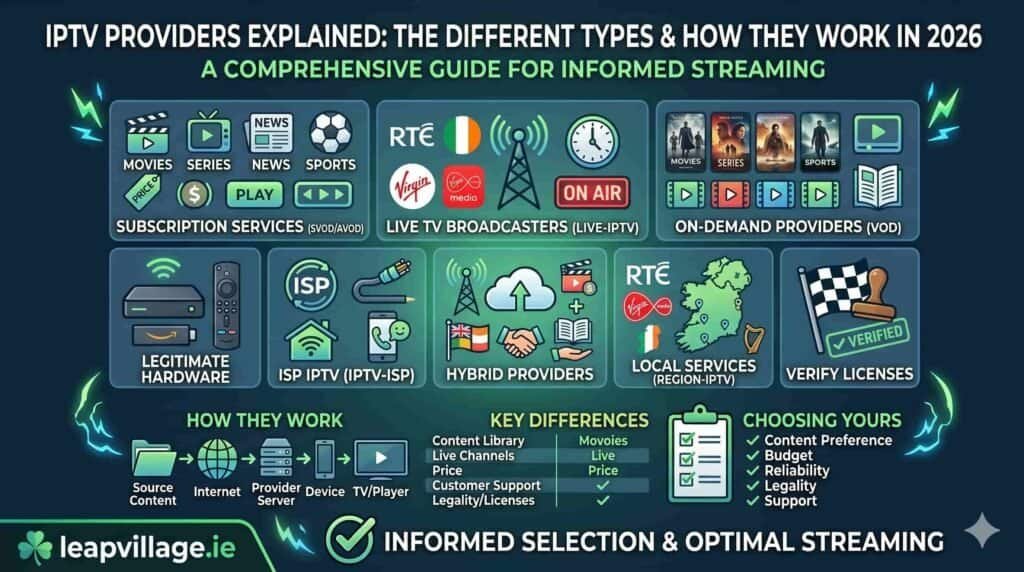
Now that you understand how IPTV providers work, here is how to apply that knowledge when choosing one. These are the questions to ask of any provider you are considering.
Do they run their own operation, or are they a reseller? A provider that runs its own servers and operation offers more accountability and reliability than an anonymous reseller. Look for an established business with a real presence.
Have they invested in proper infrastructure? The proof is in peak-time performance. The only way to truly test this is to use the service during a busy period — which is why starting with a short plan and testing during a major match is essential.
Is their pricing sustainable? Be deeply suspicious of prices that are too good to be true. A sustainable price funds the reliability you need. Impossibly cheap or « lifetime » offers signal an operation that will not last.
Do they have a real business presence? A professional website, published terms of service, a refund policy, and consistent operation over time all indicate a serious provider rather than a fly-by-night operation. LeapVillage publishes full terms and conditions and operates transparently.
Do they offer genuine support? IPTV occasionally requires troubleshooting. A provider with responsive, knowledgeable support through a real channel like WhatsApp is vastly more valuable than one that disappears after taking your payment. Test the support before you buy by asking a question.
Can they show you what you are buying? A legitimate provider will provide a channel list before payment so you can confirm it includes what you want. Refusing to do so is a warning sign.
What Separates the Best IPTV Providers From the Rest
After understanding the categories, the technology, and the pricing, it becomes clear what genuinely separates the best IPTV providers from the rest. It is not the headline channel count — almost everyone claims tens of thousands of channels. It is the fundamentals that you cannot see in an advertisement.
The best IPTV providers invest in infrastructure that holds up under peak load, so your stream works when it matters most. They price sustainably, so they are still operating next year when you want to renew. They operate transparently, with real websites, published terms, and honest communication. They provide genuine, responsive support from real people who know the service. And they build a track record of reliability over months and years rather than appearing overnight with impossible promises.
These qualities are not glamorous. They do not make for exciting marketing. But they are exactly what determines whether your IPTV experience is a reliable pleasure or a frustrating disappointment. When you evaluate IPTV providers through this lens — looking past the channel counts and the cheap prices to the fundamentals of infrastructure, sustainability, transparency, and support — you make a far smarter choice.
How LeapVillage Operates as an IPTV Provider
In the interest of transparency — which is exactly what we have argued separates good IPTV providers from bad ones — here is how LeapVillage operates.
We run our own service with infrastructure built to handle peak demand, including anti-freeze server technology engineered specifically for major sporting events when demand spikes. We price sustainably — €14.99 per month up to €49.99 per year — at a level that funds reliable infrastructure and genuine support rather than the unsustainable bargain-basement pricing that signals a short-lived operation. We operate transparently with a real website, published terms and conditions, and a 24-hour money-back guarantee. We provide genuine 24/7 support through WhatsApp, staffed by real people, not bots. And we encourage every potential subscriber to test us during a busy period before committing to a long plan, because we are confident in how the service performs.
We are not asking you to take our word for any of this. We are inviting you to evaluate us against the same framework you would apply to any IPTV provider — and to test the service yourself before committing.
Choose Your IPTV Provider Wisely
Understanding how IPTV providers work transforms you from a vulnerable consumer into an informed one. You now know the different types of providers, how the technology delivers your channels, why prices vary so wildly, and what genuinely separates the reliable services from the operations that will take your money and disappear.
Apply this knowledge. Look past the marketing claims and the cheap prices. Evaluate providers on infrastructure, sustainability, transparency, and support. Test before you commit. And choose a provider that operates like a real business because it is one.
If you would like to evaluate LeapVillage as your IPTV provider, browse our plans on the subscription page, review our terms and conditions, and message us on WhatsApp to ask questions and request the full channel list. Our Irish support team is available 24/7.
For more guidance, explore our honest buyer’s guide, our guide to buying an IPTV subscription safely, and our beginner’s guide on the LeapVillage blog.
Understand the industry. Choose with confidence. Welcome to LeapVillage.